
Make your Lasting Powers of Attorney
Online, checked by a solicitor, and guided all the way to registration.
£95 for one LPA, just £180 for both, including VAT.
- Our fee. £95 for one LPA or £180 for both, including VAT. There is nothing else to pay us.
- Registration. £92 per LPA, paid straight to the Office of the Public Guardian. It is £46 if you earn under £12,000 a year, and certain benefits remove it altogether.
- What is included. Our plain-English questionnaire, ready-written preferences and instructions, a solicitor’s check before you sign, and step-by-step help with signing and registering.

Winner: Best Use of Technology

2025-2026: NHS Dementia Innovator

Winner: Best Innovation

Is it legally valid?
Yes, once it is registered. We prepare the forms. You sign them and we’ll guide you through registration with the Office of the Public Guardian.Can I use my LPA straight away? →Who checks it?
One of our solicitors reads and approves every LPA before you sign it. You can check their credentials on the public registers.Meet our solicitors →How long does it take?
Our questionnaire takes about 10 to 15 minutes per person. The Office of the Public Guardian says registration takes 8 to 10 weeks if there are no mistakes.More questions answered →
Future-proof your life
Your Lasting Powers of Attorney let you choose people you trust to make decisions for you. They can act if you become unable to make decisions for yourself. We provide solicitor-approved LPA safeguards to protect yourself and your attorneys. Give your future self the peace of mind that your wishes are clearly expressed.
Professional safeguards
Access safeguards that are not available through self-prepared LPAs, through our solicitors and guided online drafting system.
Your property and finances
Get greater control over how your property and finances are managed after you pass the reins to your attorneys.
Your care and treatment
Make your wishes about your future care and medical treatment clear to your attorneys and medical professionals alike.
How to make your LPAs
Capacity Vault gives affordability, accessibility and safety. Professional oversight, insurance, and important options for your future care and finances that you would not receive if you went direct to the OPG. More accessible and affordable than a traditional solicitor or will writer.
- Use a solicitorAdvice tailored to you. The published fixed fees we found are £600 to £900 for both LPAs for one person, plus registration.
- Capacity Vault£180 for both LPAs. Choose from ready-written clauses, add your details, and a solicitor checks everything before you sign.
- Go direct to GOV.UKNo checks before you sign, no professional guidance about how to protect your wishes. Cheap though: just the £92 registration fee. Mistakes are common, and cost £46 per re-submission.
Who checks your documents?
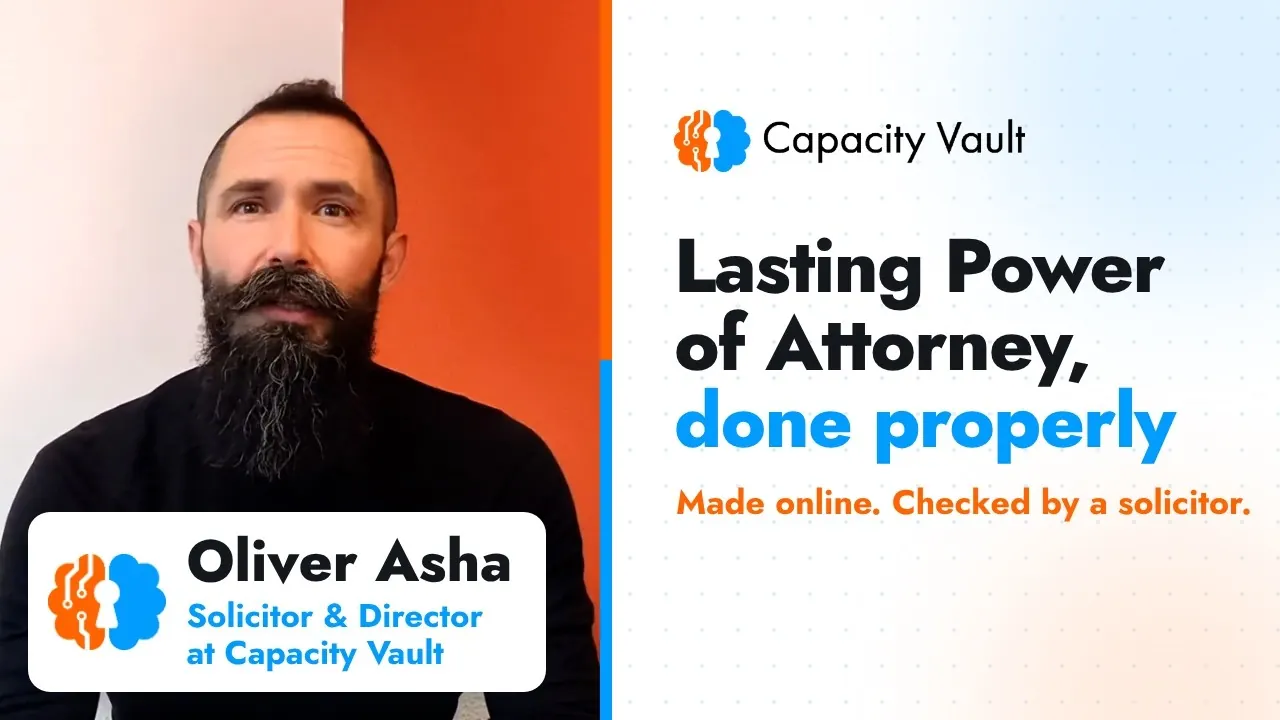
One of our solicitors will read and approve your LPAs before we send them to you to get them signed, witnessed and registered with the OPG. You can see our team below and check their credentials on the register with the Solicitors Regulation Authority, the Law Society or with the Society of Trust and Estate Practitioners.


Kate Scott
Solicitor of England and Wales, specialising in wills, trusts, lasting powers of attorney and lifetime tax planning.
Call us on +442071932747 if you have any questions.
How does it work?
1
Answer the questions
Our questionnaire asks about you, the people you want to appoint and how you want them to act. It is written in plain English. You can stop part way through and come back to it.
2
A solicitor checks it
A solicitor reads your answers and your draft documents before you sign anything. If a choice you have made could cause trouble later, we tell you about it while it is still easy to change.
3
Sign, witness and register
Signing an LPA has to happen in a set order, and getting it wrong is the usual reason one gets rejected. We tell you who signs what and when, then guide you through registering it.
Pricing: what does it cost?
Two separate things to pay for: our fee for preparing and checking the documents, and a registration fee that goes to the Office of the Public Guardian.
How our pricing compares
Every price includes VAT, and there is nothing else to pay us. The Office of the Public Guardian then charges £92 to register each LPA, paid straight to them. It is £46 if you earn under £12,000 a year, and certain benefits remove it altogether.
Prices for one person, from each provider's website in September 2026, excluding the £92 registration fee. (a) Includes registration fees. (b) Via Santander Select; Hugh James publishes no price itself. The services differ: ours is online, with a solicitor checking everything before you sign. Sources: Octopus Legacy · Farewill · Santander · OPG fee.
What it costs to leave it
If you lose capacity without an LPA, nobody can simply step in. Someone has to apply to the Court of Protection to be made your deputy.
That application costs £432, and a deputy then pays up to £320 in supervision fees every year. It is slower and more limited than the LPA would have been, and you get no say in who is appointed.
What is not included?
- Print & Post (coming soon). If you don't have a printer we can send the documents to you. For now your LPA arrives as a PDF for you to print. An LPA has to be signed in wet ink on one original document, so printing it is a real step, not a formality.
- Business LPAs. If you run a business and want different attorneys looking after it, this service is not the right one. Please get in touch before you start.
- England and Wales only. An LPA made here is binding in England and Wales. It does not cover assets or decisions elsewhere.
What are the two types?
Property and financial affairs
Your money and your things. Your attorneys can run your bank accounts, pay your bills, deal with your pension and sell your home. You choose whether they can start as soon as the LPA is registered, or only once you lose capacity.What it does, and what your instructions addHealth and welfare
Your care and your treatment. Your attorneys can decide where you live, what your daily routine looks like and what medical care you get. You can also give them the power to accept or refuse life-sustaining treatment. This type can only be used once you cannot make the decision yourself.What it does, and what your instructions add
Most people make both. They are two separate documents, and each one carries its own fee.
Already have an LPA?
An LPA can be attacked in much the same way a will can. Someone can object while it is being registered, or argue years later that you did not really understand it, or that somebody talked you into it. By then you may not be able to answer for yourself.
With Capacity Vault's Capacity Snapshot you can get a digital snapshot of your Mental Capacity at the time you make your LPA. The stronger evidence you have, the less chance of a successful challenge.
Frequently asked questions
Who can make an LPA?
Anyone aged 18 or over who has the mental capacity to make it. You do not have to live in the UK or be a British citizen, but the LPA only works for decisions and assets in England and Wales. Our guide explains the two types of LPA and which you need.
Can I make an LPA for somebody else?
No. An LPA can only be made by the person it belongs to, and only while that person still has the mental capacity to make it. You can help someone find the service and sit with them while they use it, but the answers, the reading and the signature have to be theirs.
That applies to our pairing option too. Two people can make their LPAs together, and most couples do, but each person enters their own answers, reads their own documents and signs for themselves. One of you cannot do it for the other.
If capacity has already gone, an LPA is no longer possible for that person and an application to the Court of Protection is the route instead. Our guide covers what to do if you have concerns about someone's capacity.
Who can I appoint as my attorney?
Any individual aged 18 or over. Most people choose a spouse or partner, an adult child, or a close friend. For a property and financial affairs LPA there is one extra rule: your attorney must not be bankrupt or subject to a debt relief order. The person who knows you best need not be an attorney: our guide explains how to have your attorneys consult family and each other.
Can I appoint more than one attorney?
Yes, and most people do. You decide whether they have to agree every decision together, which the law calls acting jointly, or whether any one of them can act alone, which is called acting jointly and severally. The questionnaire explains the trade-off. If you say nothing, the law treats them as appointed jointly. Our guide covers attorneys consulting each other, including when different people hold your two LPAs.
Can I give my attorneys instructions?
Yes. Both types of LPA have a section for preferences, which your attorneys should bear in mind, and instructions, which they must follow. Our questionnaire offers ready-written clauses for both, on subjects from gifts and investments to care homes and medical treatment. A solicitor checks your choices before you sign. Our guide explains every clause and why it matters.
What is a certificate provider?
Someone independent who signs your LPA to confirm you understand it and that nobody has pressured you into it. Every LPA needs one. They cannot be one of your attorneys. We tell you who is allowed to do it and what they are agreeing to. Our guide to making an LPA step by step shows where the certificate provider fits in.
How long does it take?
Our questionnaire takes about 10 to 15 minutes per person. Registration is the slow part: the Office of the Public Guardian says 8 to 10 weeks if there are no mistakes in the application. Mistakes are common, which is the main reason we check the documents first. There is more on what it costs and how long it takes in our guide.
Can I use my LPA straight away?
Not until it is registered. An LPA that has not been registered gives your attorneys no authority at all. Once a property and financial affairs LPA is registered your attorneys can act with your permission. A health and welfare LPA can only be used once you cannot make the decision yourself. Our guide explains the difference between the two types.
Can I change my mind later?
Yes. You can cancel an LPA at any time while you still have the mental capacity to do so. That is one reason not to put it off. Our guide explains what mental capacity means in law.
Do I need a will as well?
Yes, and the two do different jobs. An LPA covers decisions while you are alive. A will covers what happens to your estate after you die. Neither one does the other's work. Your LPA can also tell your attorneys how to treat your will: see your will and your records in your LPA.
Where can I read more about LPAs?
Our resources page has plain-English guides, including:
- Which type of LPA do you need?
- How to make an LPA on GOV.UK
- Instructions and preferences: telling your attorneys what you want
- Living wills and health and welfare LPAs: which should you choose?
- What is mental capacity?
Parliament passes Bill enabling digital LPAs covers the law that allows LPAs to be made digitally.
What if I am worried about my own capacity?
Tell us before you start. You can only make an LPA while you still have capacity, so this is worth looking at properly rather than hoping. If capacity has already gone, an LPA is no longer possible and a Court of Protection application is the route instead. Our guide sets out what to do if you have concerns about capacity.
Get your LPAs done now
An LPA is only available to you while you can still make your own decisions. Answer the questions, let a solicitor check them, and have it done.
This page is general information about lasting powers of attorney and is not legal advice for your own situation. If your circumstances are complicated, please get in touch before you start.
Sources
- Mental Capacity Act 2005, section 9 on legislation.gov.uk
- Mental Capacity Act 2005, section 10 on legislation.gov.uk
- Lasting power of attorney: overview on GOV.UK
- Make a lasting power of attorney on GOV.UK
- Register a lasting power of attorney on GOV.UK
- LP12: Make and register your lasting power of attorney, Office of the Public Guardian
- LPA fees, The Legal Practice and LPA costs, PDA Law, both checked on 26 October 2026
- Become a deputy: fees on GOV.UK